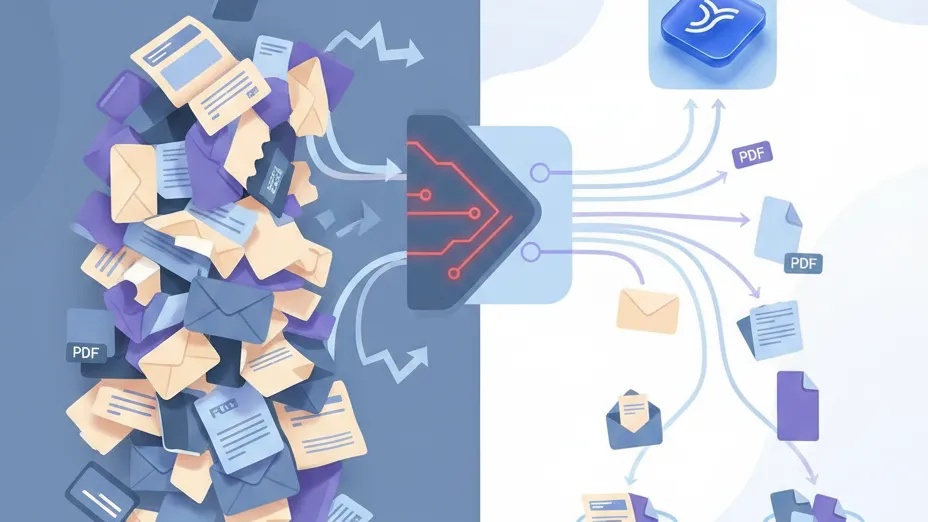
Your last automation project is sitting in a queue with someone's name on it, waiting for a human to handle the part the bot couldn't. Maybe it's a CV the parser didn't understand. Maybe it's a vendor invoice with a new layout. Maybe it's a tenant email that wasn't a maintenance request, a complaint, or a rent inquiry. Whatever it is, the bot you paid $25K to deploy in 2022 is still broken at exactly the same edge. Because the bot was never the problem. The fix isn't another bot. It's managed AI automation for agencies that redesigns the workflow underneath the agent.
Managed AI automation is a service model where a provider redesigns a business workflow end-to-end, embeds an AI agent inside the redesigned process, and stays accountable for the operational outcome. Not a tool, not a license, not a bot the buyer has to integrate and maintain on their own.
EY's global RPA consulting practice, which spans 20 countries, is widely cited as putting initial RPA implementation failure rates at 30–50% [R1]. That's not a fringe stat. That's the consultancy that sold a lot of those projects telling you, on the way out, that half of them don't work.
Forrester's numbers track with what you're already feeling. 45% of firms see RPA bots break on a weekly basis or more often [R2]. A majority report struggling with performance and scalability past the initial pilot [R3]. Deloitte surveyed 479 executives across 35 countries and asked what's actually blocking automation at scale. The answers: integration issues (62%), lack of skills (55%), and the inability to change how the business actually works (52%) [R4].
Read that last one again. The top three reasons automation stalls all describe the workflow underneath the bot. Not the bot itself. The bot did what it was told. The workflow it was bolted onto was the broken part.
Three different industries. One identical failure mode: unstructured input.
A senior developer's CV comes in as a PDF. No headings. Skills buried in a paragraph about a side project. Dates in a format the parser hasn't seen. Your recruiter spends fifteen minutes reading it the way humans read things, then keys it in by hand. The "automated" pipeline just got bypassed.
A vendor you've used for eight years sends an invoice with a redesigned layout. Same vendor, same line items, same totals, different position on the page. Your RPA bot, which was trained to grab values from specific coordinates, drops the invoice into an exception queue. Your AP clerk handles it manually. Next month, same vendor, same new layout, same exception queue.
A tenant emails the property manager: "Hi, I think there's been a mistake with my account but I'm also going to be away next week and the gate code isn't working for my partner — can you check?" That email is three tickets in one paragraph, and none of them match the keyword filters the bot uses to route mail. It sits in a general inbox for two days.
This is the failure mode at the heart of every RPA vs agentic AI debate. And it's where agent-based systems separate from scripted bots in a way that shows up in the numbers. Artificio's 2025 study analyzed 500,000 document-processing transactions across healthcare, finance, logistics and real estate. AI agents averaged 40% higher accuracy than RPA on documents with variable layouts [R24]. In healthcare, agents hit 94% accuracy versus 61% for RPA. In financial services, agents delivered 89% straight-through processing versus 53% for RPA [R24]. Same documents. Same workflows. Different machinery underneath.
Here's the part that should worry you if you're about to write another check.
McKinsey's State of AI 2025 tested a wide range of organizational attributes against EBIT impact from generative AI. Workflow redesign had the biggest effect on whether an organization actually saw money on the bottom line. Bigger than model choice, bigger than vendor, bigger than budget [R9].
Only 21% of organizations using gen AI have redesigned even some of their workflows. More than 80% report no tangible EBIT impact at the enterprise level [R10]. Same shape as the RPA story, told ten years later with a new label on the box.
Gartner is already calling it. Over 40% of agentic AI projects will be canceled by the end of 2027, the analysts say, because of escalating costs, unclear business value, and inadequate risk controls [R5]. Of the thousands of vendors claiming agentic AI capabilities, Gartner reckons roughly 130 have anything genuinely agentic. The rest are doing what Gartner calls "agent washing" — rebranded RPA, repackaged chatbots, same brittleness in a fresh wrapper [R6].
Forrester's Bernhard Schaffrik put it plainly: the AI agent market is on track to repeat RPA's mistakes — "an unmanageable number of AI agents with overlapping functionalities, poor governance, and high run and maintenance costs" [R22]. He wrote that in 2024. The mistake is already in motion.
Across recruitment, accounting and property management, the firms pulling away from the pack aren't buying agents off a shelf. They're redesigning a workflow and embedding an agent inside it. The numbers are loud.
In recruitment, Bullhorn's Amplify AI is posting 51% more candidate submissions, 22% higher fill rates, and 85% of candidates rating the AI-assisted screening experience positively [R14]. Bullhorn's GRID 2026 industry report surveyed nearly 2,300 recruitment professionals globally [R13]. It found top-performing staffing firms were four times more likely to be using AI [R11]. 55% of firms using AI screening reported KPIs jumping by more than 25%. 46% said AI cut screening time in half or better. Only 10% have AI embedded across the full workflow [R12]. Which means the runway here is enormous, and the firms already on it are leaving everyone else behind.
In CPA work, Thomson Reuters' Audit Intelligence Test has dropped audit testing time from 16 hours to 5–6 hours per engagement. Brad Oberlander, a CPA firm owner using it, put it bluntly: "With Audit Intelligence Test, what used to take me two full days — around 16 hours — now takes just five to six hours per engagement." CoCounsel Document Analysis early adopters are seeing up to 70% faster preparation and workpaper review [R15]. Karbon's State of AI in Accounting 2025 surveyed 500+ accounting professionals across six continents. It found firms embracing AI save 18 hours per employee per month, mostly on email drafting (63%) and meeting summaries (40%). 56% of respondents said firm value drops without AI [R16].
In property management, AppFolio's Realm-X platform is posting numbers that, if you run a mid-sized firm, are worth re-reading slowly: 12.5 hours saved per week on communications, reporting and training. Vacant units fill 5.2 days faster. Renewal rates up 20%, net operating income up 2.8% after deploying Realm-X Flows. 95% of users see benefit within weeks [R18]. Realm-X Performers users hit a 73% higher lead-to-showing conversion rate [R19]. And the broader AppFolio benchmark, which surveys over 2,000 property management professionals, shows AI usage climbed from 21% to 34% in a single year, while "no plans to use AI" collapsed from 51% to 37% [R17].
None of these wins are about buying an agent. They're about redesigning the work the agent does.
Honest counterpoint, because the agency owner who reads this and rips out their entire automation stack will be sending me an angry email in six weeks.
There are workflows where deterministic, scripted, audit-trail-everything RPA still beats an agent and will keep beating one. Payroll runs. ERP postings. Structured invoice entry where the vendor template hasn't changed in five years and the regulator wants to see exactly which steps fired in exactly which order. You don't want a probabilistic agent making a judgment call on a tax filing. You want a bot that does the same thing the same way every single time, that you can test exhaustively, that fails loudly when something changes.
The shift isn't "RPA is dead." The shift is that RPA stops being the system and starts being a sub-skill the agent calls when the workflow needs a deterministic action. The agent reads the unstructured email, decides what it is, and hands off to a scripted routine for the part that has to be exact. Different tools for different parts of the same job.
Pick one workflow. Just one. The one with the most unstructured input dragging it down.
For a recruitment firm, that's almost always CV review and candidate screening. For a CPA, it's vendor invoice processing or first-pass document review. For property management, it's tenant communication triage — the inbox that swallows your weekends.
Measure the baseline. How many hours a week does your team currently spend on it. What the loaded wage is of the people doing it. What the error rate is.
Then bring in a managed AI provider, not a tool vendor, to redesign the workflow and embed the agent. The redesign is the work. The agent is the part you stop seeing once it's running.
Re-measure at day 30. If the hours you recovered, multiplied by the loaded wage, don't beat the implementation cost in the same quarter, kill it. Walk away. Try a different workflow or a different provider.
This is the test the 80% who saw no EBIT impact from gen AI never ran [R10]. Run it.
What's the difference between traditional RPA and agentic AI? Traditional RPA follows scripted rules and breaks the moment a UI or document layout changes. Agentic AI observes what's actually in front of it, reasons about what to do, and acts. AI agents average 40% higher accuracy than RPA on documents with variable layouts and reach 94% accuracy on healthcare documents where RPA scores 61% [R24].
Why do most automation projects fail? EY reports 30–50% of initial RPA implementations fail [R1]. Deloitte's top three barriers — integration (62%), skills (55%), and inability to change how work gets done (52%) — all describe the workflow rather than the technology [R4]. McKinsey names workflow redesign as the single biggest predictor of EBIT impact from gen AI, and only 21% of organizations have done it [R9, R10].
What does "managed" actually mean in managed AI automation? It means a provider who redesigns the workflow with you, embeds the agent inside the redesigned process, and stays accountable for the outcome. Not someone who sells you a tool and a login. The distinction matters because, as Forrester's Bernhard Schaffrik warned, the alternative is an unmanageable sprawl of agents with overlapping functions, poor governance, and runaway maintenance costs [R22].
Can I just buy an AI agent tool instead of going managed? You can, and Gartner predicts more than 40% of those projects will be canceled by the end of 2027 [R5]. Of the thousands of vendors claiming agentic capability, only around 130 have anything genuinely agentic. The rest are RPA and chatbots in new packaging [R6]. The firms winning are the ones buying redesigned workflows, not tools.