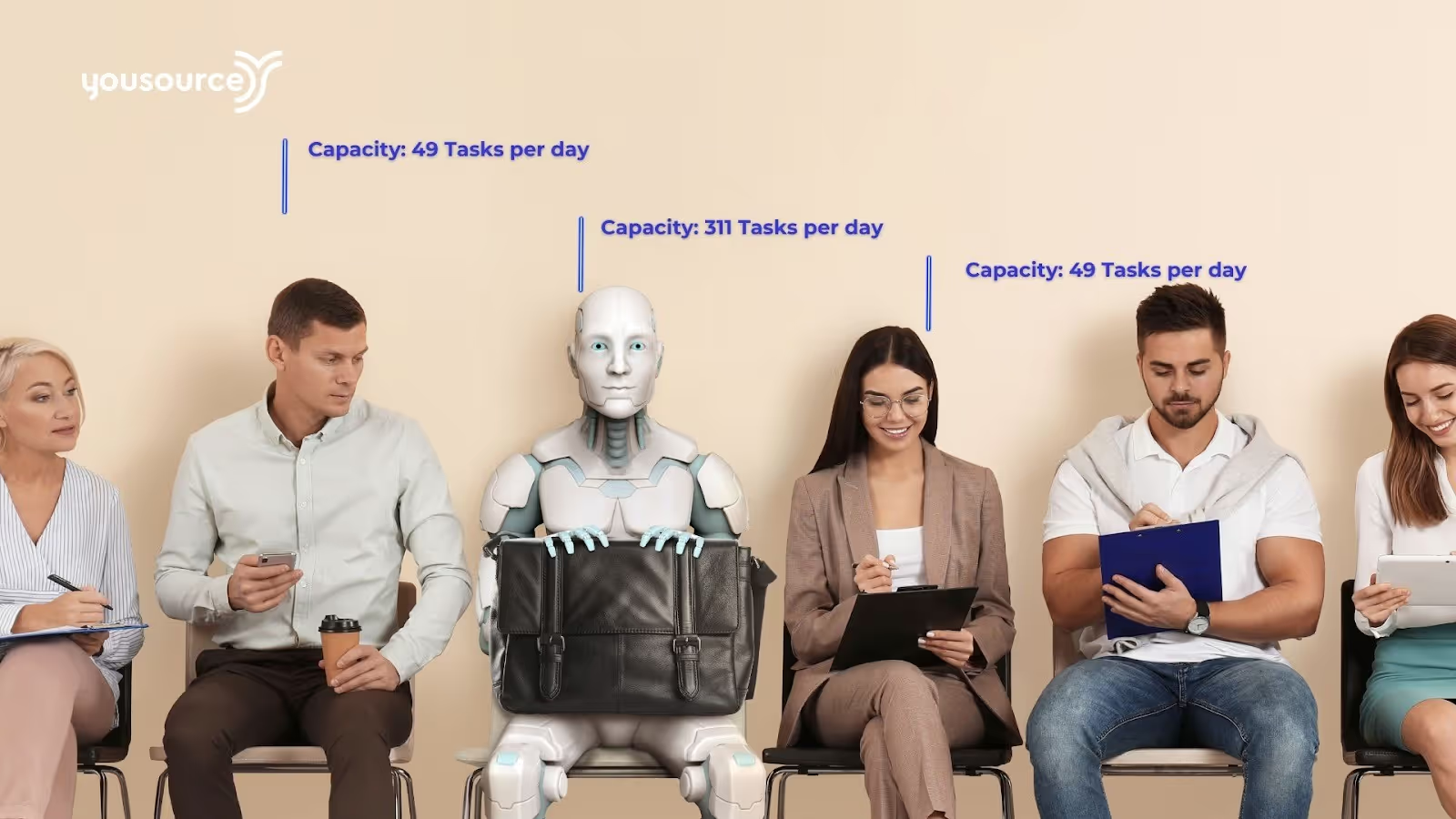
McKinsey now counts roughly 60,000 “workers.” About 40,000 are human. Around 25,000 are AI agents.
That number alone should reset how business leaders think about artificial intelligence. McKinsey is no longer treating AI as a productivity add-on or an internal efficiency tool. It is treating agentic AI as a real layer of labor capacity, on par with human employees. Within the next 18 months, the firm wants every consultant paired with at least one AI agent.
It represents a fundamental shift in how work is structured, delivered, and monetized — and it has implications far beyond elite consulting firms. For small and medium-sized enterprises (SMEs), this signals the arrival of superagency: a future where lean teams outperform larger competitors by deploying AI agents as scalable, always-on collaborators.
For decades, consulting firms scaled in a predictable way. Senior partners sold insight and credibility. Junior consultants did the heavy lifting: research, data gathering, synthesis, spreadsheet modeling, and slide production.

That model worked when:
But as data exploded and decision cycles shortened, the model became fragile. Repetitive analytical work grew more expensive, slower to execute, and harder to staff. The real bottleneck wasn’t expertise — it was execution capacity.
AI agents remove that bottleneck.
An AI agent is not just a smarter chatbot. It is better understood as a workflow runner.
Instead of responding to a single prompt, an agent can:

In practice, this means an agent can search across multiple data sources, summarize findings, draft structured narratives, generate charts or code, format outputs, and document its own research trail — all with far less human back-and-forth.
For a consultant, that changes the job overnight. Instead of spending days assembling a first draft, they can request a client-ready analysis and receive a structured first pass that already includes supporting evidence and draft artifacts. Human expertise shifts from production to judgment, refinement, and decision-making.
McKinsey says its internal AI transformation is being driven by QuantumBlack, its advanced analytics and AI unit. According to the firm, AI-enabled work now accounts for roughly 40% of its overall work mix.
That figure matters less than what it represents: consulting expertise is being productized. Repeatable analytical work is no longer delivered primarily through billable hours but through agent-driven systems that can be reused, refined, and redeployed.
McKinsey CEO Bob Sternfels has framed this as a business model shift. Instead of billing mainly for advice, the firm increasingly teams with clients on business cases and ties compensation to outcomes. That’s far easier to do when software agents continue delivering value long after kickoff meetings end.
This is consulting moving closer to software — and software moving closer to strategy.

Large firms like McKinsey can afford massive AI investments, but SMEs stand to gain even more from agentic AI.
Why? Because agents collapse traditional advantages of scale.
An SME with a small leadership team and the right AI agents can now:
What used to require layers of junior staff can now be handled by a handful of well-orchestrated agents. This creates superagency: the ability for individuals and small teams to operate at a level previously reserved for large organizations.
In effect, AI agents turn fixed labor costs into elastic capacity.
The biggest mindset shift for SMEs is moving from “AI as a tool” to “AI as a teammate.”
Tools wait for instructions. Agents take initiative within defined constraints. When deployed properly, they:
This is not about replacing people. It’s about amplifying them. The most effective organizations will be those that design workflows where humans and agents collaborate by default.
If McKinsey is any indicator, the future of professional services — and business more broadly — will not be decided by headcount. It will be decided by how well organizations encode their expertise into agent-driven systems.
Firms that win will:
For SMEs, this is an opportunity to leapfrog. Instead of trying to scale teams linearly, they can scale capability. Instead of outsourcing expertise, they can embed it.
McKinsey’s 25,000 AI agents are not an anomaly. They are a preview. Superagency is no longer theoretical — it is operational. And for SMEs willing to rethink how work gets done, the gap between small and large has never been narrower.