Could agentic AI make the U.S. voting system fraud-proof?
The SAVE Act drama unfolding in Washington isn't just another partisan skirmish — it's a glaring symptom of a deeper structural mismatch in how we handle high-stakes verification at scale.
With 49 out of 53 Republican Senators now cosponsoring versions of the bill (including the original Safeguard American Voter Eligibility Act and evolved proposals like the SAVE America Act), President Trump urged the party to nuke the filibuster if necessary, holdouts like Sen. Lisa Murkowski drawing sharp criticism, and mounting pressure to attach it to must-pass legislation like FISA extensions, the momentum is undeniable.
Yet the bill remains stalled in the Senate, where it needs 60 votes to overcome procedural blocks.
Meanwhile, a surprising global contrast sharpens the irony: Several countries have already implemented advanced digital or biometric voter systems that enable faster, more secure verification — often at national scale — while the U.S. debates basics.
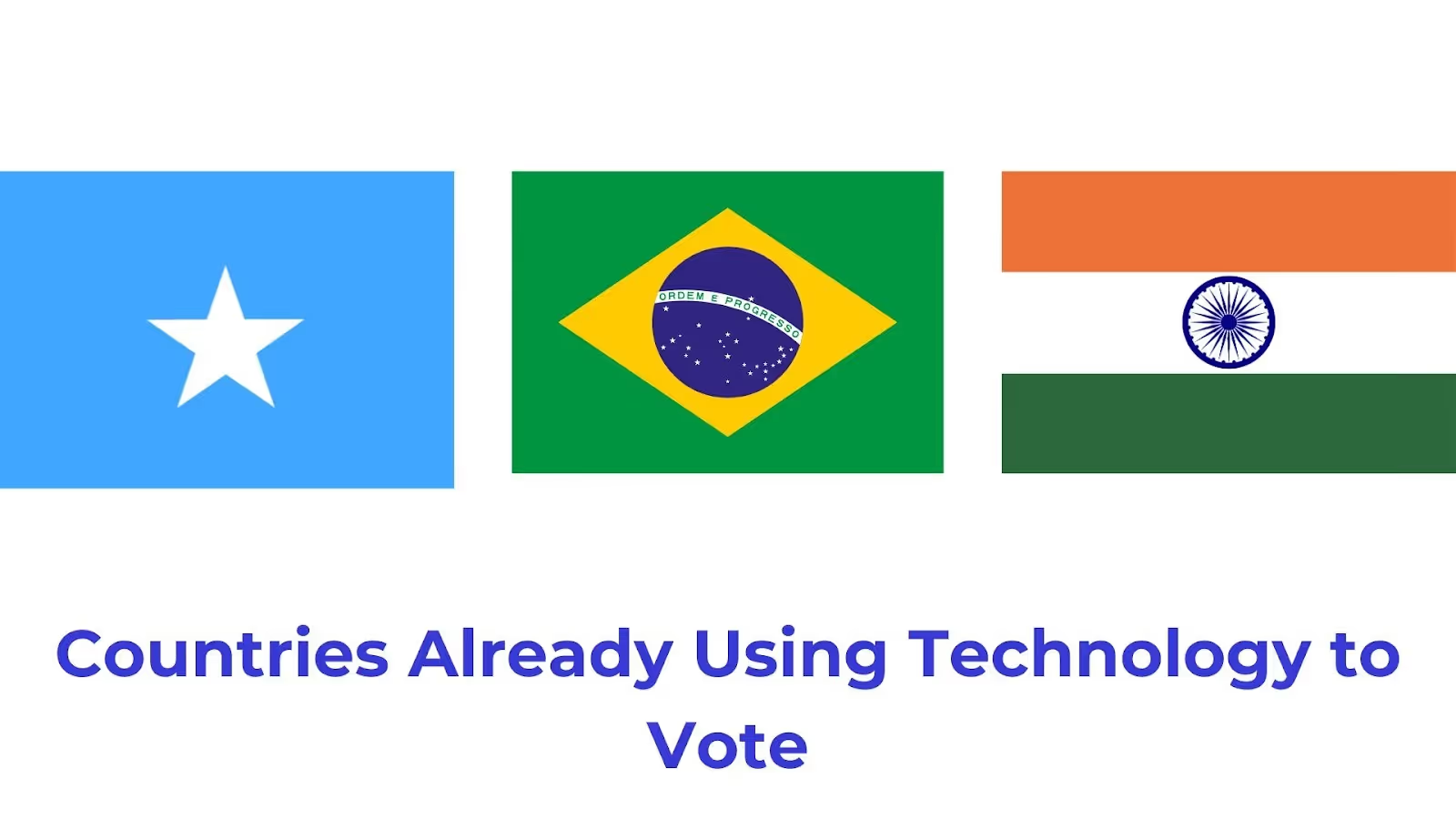
Countries Already Using Technology to Vote
Estonia stands as the global pioneer of internet voting (i-Voting). Since 2005, it has been the only country where all citizens can cast ballots online in national and local elections using a secure, government-issued digital ID card (with options like Mobile-ID or Smart-ID). The system supports remote voting from anywhere with internet access, authentication via public key infrastructure, and verifiable anonymity. In recent elections, over 50% of votes have been cast digitally, demonstrating high trust and scalability in a fully digital framework.
Brazil has deployed widespread biometric voter identification since expanding fingerprint-based systems in 2008. By the 2024 municipal elections, over 132 million voters — about 83% of the electorate — used biometric verification at polling stations via electronic voting machines. The goal is near-100% coverage by the 2026 national elections, significantly reducing fraud through mandatory, free in-person biometric enrollment (fingerprints and photos).
India, the world's largest democracy, links its Aadhaar biometric national ID (with fingerprints and iris scans for over a billion people) to voter IDs on a voluntary but encouraged basis. Electronic voting machines (EVMs) with voter-verified paper audit trails (VVPAT) have been standard since the early 2000s for national and sub-national elections. Recent pilots, like Bihar's 2025 municipal elections using a mobile app-based e-voting system (with blockchain and facial recognition elements), achieved high turnout and remote access for overseas voters.
Somalia is advancing its national digital ID system, managed by the National Identification and Registration Authority (NIRA). Launched in 2023, it issues biometric national ID cards (with fingerprints) and aims to distribute up to 15 million by the 2026 elections to support one-person-one-vote integrity. The program includes self-service online applications and has been extended for free issuance into 2026, addressing decades without formal IDs and preparing for secure verification amid rebuilding efforts.
Machine-Assisted Governance
These examples — from Estonia's seamless remote digital voting to Brazil's massive biometric polling and India's Aadhaar-integrated scale—show that secure, machine-assisted verification is achievable even in diverse contexts.
This structural lag in the U.S. extends beyond voter systems to broader government operations. While legacy processes remain heavily human-dependent and prone to bottlenecks, several countries are already deploying agentic AI in public sector services.
These deployments demonstrate how decoupling human friction from complex workflows can deliver verifiable, machine-speed efficiency.
Singapore leads with virtual assistants like "Ask Jamie," which has handled over 15 million queries across 80+ government websites, resolving many issues autonomously and reducing call center loads. Singapore also launched the world's first dedicated Model AI Governance Framework for Agentic AI in early 2026, guiding safe deployment of autonomous systems.
Estonia is piloting Bürokratt, a network of interoperable agents that cross agency boundaries. A citizen can request a passport renewal, and the agent autonomously coordinates with relevant departments like border control, making the government feel cohesive rather than fragmented.
The United Kingdom has deployed autonomous agents like Bobbi (powered by Salesforce Agentforce) in police forces. In its first week, Bobbi resolved 82% of inbound queries without escalation, handling FAQs and case logging 24/7.
The United Arab Emirates (UAE) is pushing toward the world's first "AI-native government" by 2027, with tools like the TAMM app (resolving 95%+ of service requests via conversational AI) and TAMM AutoGov, described as the world's first AI public servant.
India advances "sovereign" AI agents through initiatives like the Citizen Stack, enabling customized digital tools for identity, payments, and services, supported by strong national AI strategies.
Its Not About Politics - Its About Outdated Architecture
The media frames the U.S. debate as pure left-vs.-right warfare: Republicans pushing "election integrity," Democrats warning of voter suppression. That lens misses the bigger picture. The real issue isn't ideology — it's outdated architecture.
Consider economics. Election administration in the U.S. costs between $4 billion and $6 billion in a typical cycle, spiking higher during high-turnout years (estimates reached $10 billion in 2020 due to pandemic measures). Much of this spending goes toward staffing, equipment maintenance, postage, auditing, and combating fraud risks through labor-intensive verification. Voter registration databases alone require millions annually to maintain, while replacing outdated polling equipment can add hundreds of millions more over time. Every cycle pours billions into administrative overhead, endless delays, rework from mismatches, and security patches for human-error vulnerabilities. This isn't efficiency—it's a hidden "latency tax" baked into the system.
An agentic approach changes the equation entirely. Agentic systems—autonomous AI-driven agents that plan, execute, and verify tasks with minimal oversight—flip verification and service delivery from rigid, labor-heavy drudgery to fast, scalable, built-in intelligence. Imagine:
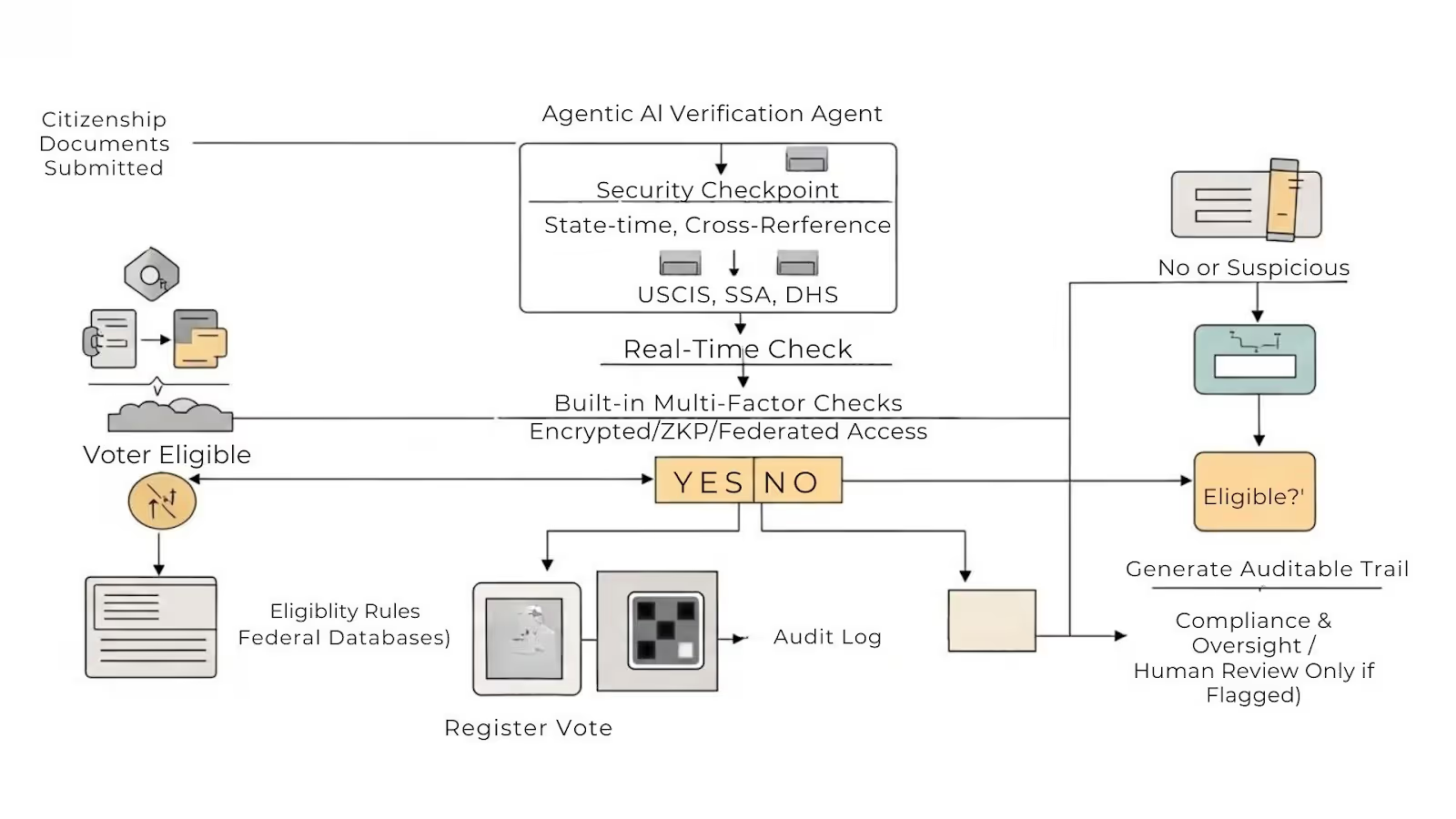
An agent cross-references citizenship documents against federal and state databases in real time using secure, privacy-preserving protocols.
It applies machine-speed rules for eligibility, flags anomalies instantly, and generates auditable trails without human intermediaries.
Marginal cost per verification drops toward near-zero as the system scales infinitely—no additional poll workers, no mountains of paperwork.
This isn't science fiction. In 2026, agentic AI is already reshaping identity and verification in enterprise settings and public sectors worldwide: dynamic authentication, runtime authorization, and provenance tracking for autonomous agents accessing resources. The same principles apply here — decouple human friction from tasks that demand speed and accuracy, and you unlock superagency: massive output without proportional cost or risk.