Conclusion: Reliable Execution, Delivered
Go back to the founder from the first chapter. Revenue climbing, backlog a swamp, contractors vanishing for days, and the instinct to fix it by filling a box on the org chart. That founder didn't need a fractional CTO. They needed work to ship. The seat was never the problem. The problem was that nothing was crossing the distance between a good idea in a meeting and a working feature in front of customers.
That distance is the execution gap, and it's where this whole book has been pointing. A title doesn't cross it. Neither does a retainer for two mornings a week, or advice by the hour, however sharp. All of that stays on the wrong side of the gap. The only thing that crosses it is execution: someone owning a piece of work, shipping it, then owning the next.
The spine, in one breath
Strip the book to its frame and it's four moves.
You don't hire a CTO. You hire five accountabilities wearing one job title: software delivery, team performance, operational reliability, technical quality, and roadmap and business alignment. Every one of them is an outcome you can watch land or watch slip. None of them is a personality you interview for.
Those five get delivered by how the work is run, not by who sits at the top of the chart. The thousand-page specification is the spec graveyard, obsolete before it ships and read by no one. The thing that actually works is task-based development: small, scoped, verifiable work, one task at a time, each one you can check, each one shippable on its own. The Standish CHAOS data is blunt about why. Small projects succeed 61% of the time; "grand" ones, just 6% (Standish CHAOS 2015). Size is the dominant driver of whether software ships at all. Task-shaped work is how you stay on the right side of that line on purpose.
And you know it's working because you can read it. Ten numbers on one page, two per accountability: lead time and delivery predictability; cycle time and bus factor; change-failure rate and time to restore; defect escape rate and rework ratio; percent of work tied to a business outcome and roadmap commitment accuracy. You don't run the standup. You read the scorecard, the way you read a P&L, and you ask about the line that's gone red.
| What you thought you needed | What you actually needed |
|---|---|
| A CTO on the org chart | Five accountabilities, delivered |
| A thousand-page spec | Task-shaped work, shipped one task at a time |
| To trust that engineering is "going okay" | Ten numbers you can read in ninety seconds |
| A title to hold accountable | Execution you can see, week after week |
That's the argument. Define the seat, deliver the seat, measure the seat. Nowhere in those three steps did you have to fill it with a single expensive hire.
Where the execution actually lands
The scorecard chapter ended on a catch. A founder can read all ten numbers. That was always the easy half. The hard half is having someone whose job is to move them, and to answer for the one that drifted the wrong way.
That's the part advice doesn't reach. A roadmap deck doesn't move your lead time. An architecture opinion doesn't lower your change-failure rate. Someone with hands on keyboard, shipping task after task and owning the result, is the only thing that moves a single line on that page. The accountabilities, the operating system, and the scorecard all converge on the same requirement: delivery you can count on and check.
This is Dev on Demand. Subscription engineering on a flat monthly fee, cancel anytime, built around the unit this book has called the task. You submit a task, an engineer ships it on roughly a three-day cycle, and you approve it before the next one begins. The approval gate is the accountability the title was supposed to provide and so rarely does. You see the work, you check the work, and only then does the meter move to the next piece. The proof points are on the live page: a 98.4% renewal rate, 60-plus projects delivered, a first deliverable inside five business days, a five-day replacement guarantee, and 100% IP ownership from the start.
The feature list isn't really the point. What matters is the shape of the model. You're not buying a slice of a senior person's week spent on opinions; you're buying a stream of shipped, approved, verifiable tasks. Hands on keyboard, on a cadence, against the ten numbers you already know how to read.
The next step: one real task
You don't have to take any of this on faith, and you shouldn't. The natural next step isn't a contract or a discovery phase. It's the Proof of Quality: one real task, scoped and shipped, evaluated by you before you commit to anything.
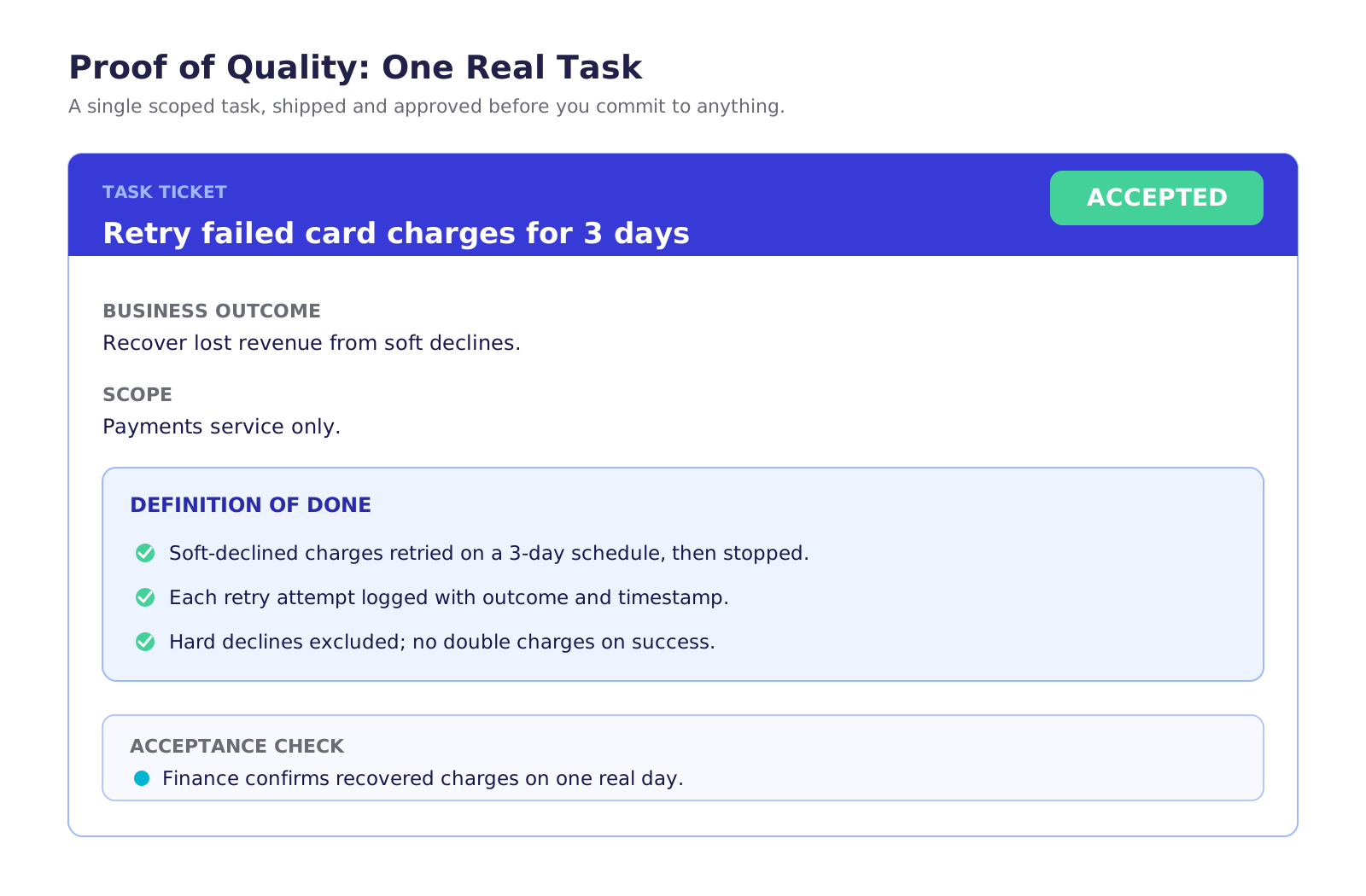
Pick something that's been stuck. Write it as a task: what it is, the outcome it serves, the scope, the definition of done, the check that tells you it's right. Hand it over. Watch it ship inside a few days. Then judge it the way you'd judge any piece of work you paid for. Did it land on time? Did it do what the ticket said? Could you read what happened without sitting in a single standup? One task tells you more about whether you'll get reliable execution than a stack of interviews ever will.
That's the whole pitch, and it's a small one on purpose. No transformation, no year-long programme. Just one task, done right, that you approve before anything else begins.
You started this book about to fill a seat. You can close it knowing the seat was never the thing. The five accountabilities are the thing, task-based development delivers them, and the ten KPIs tell you it's true. What's left is to stop shopping for a title and start buying the outcome.
Buy the execution, not the title. Outcomes, not org charts.
Your move: write one stuck piece of work as a task, and let the Proof of Quality show you what reliable execution feels like.
Download the full PDF for free?
Free download — no account required
