Roadmap & Business Alignment
A team can clear every other bar in this book and still fail here. The code is sound. The cadence holds. Nothing's on fire. And six months in, the founder looks at what got built and realises half of it serves no customer, no deal, and no number on the board. Engineering was busy. The business didn't move.
That's the alignment failure, and it's quieter than the others. An outage announces itself. A slipped launch announces itself. Building the wrong thing announces nothing. It feels like progress right up until you ask what the work was for.
What alignment actually means
Roadmap and business alignment is the discipline of making sure every piece of engineering work traces back to a commercial outcome. Not a vibe, not a stakeholder's hunch, but a specific thing the business is trying to do: win a segment, cut a support cost, unblock a renewal, hit a compliance deadline before it costs you a contract.
Public descriptions of the CTO role call this "translating technology capabilities into measurable business outcomes" (Splunk). It sounds like strategy, and the strategy part is real. But the accountability isn't having the roadmap. It's that the work flowing through the team this week actually maps to it. Plenty of companies have a roadmap. Far fewer can tell you, task by task, why each thing in flight is being built and what it's worth.
The reason this lands on engineering at all is that the gap between "what the business wants" and "what gets built" is where value leaks out. A founder says "we need to reduce churn." That sentence becomes a feature, the feature becomes a backlog of work, the backlog gets handed to whoever's free, and four steps later someone's building a settings page nobody asked for because it seemed related. Each handoff loses a little intent. Alignment is the work of not losing it.
The failure mode: building things nobody uses
Here's the number that should worry any founder funding an engineering team. Pendo, which instruments how people actually use software, found that 80% of features are rarely or never used, and roughly 12% of features drive 80% of usage (Pendo 2019). Four-fifths of what gets built barely gets touched.
Sit with that as a spend, not a statistic. Every one of those unused features was scoped, designed, built, tested, and shipped. Someone's salary paid for it. It occupies code that now has to be maintained, secured, and worked around forever. The company paid full price to build something and is now paying rent to keep it alive, and customers don't care that it exists.
This is the spec graveyard seen from the business side. A thousand-page specification doesn't just go obsolete and unread. It commits the team, up front, to building a pile of features that sounded essential in a planning room and turn out to be the 80% nobody opens. The bigger the upfront commitment, the more of it you discover, too late, you didn't need.
When nobody owns alignment, the symptoms are specific. Engineering ships steadily and revenue doesn't notice. The roadmap is a list of features rather than a list of outcomes. Sales asks for something and can't get an answer on whether it's coming. The founder can't look at the current sprint and say, in one sentence, what each item is supposed to earn. The team is executing. It just isn't executing toward anything the business can bank.
What reliable execution looks like
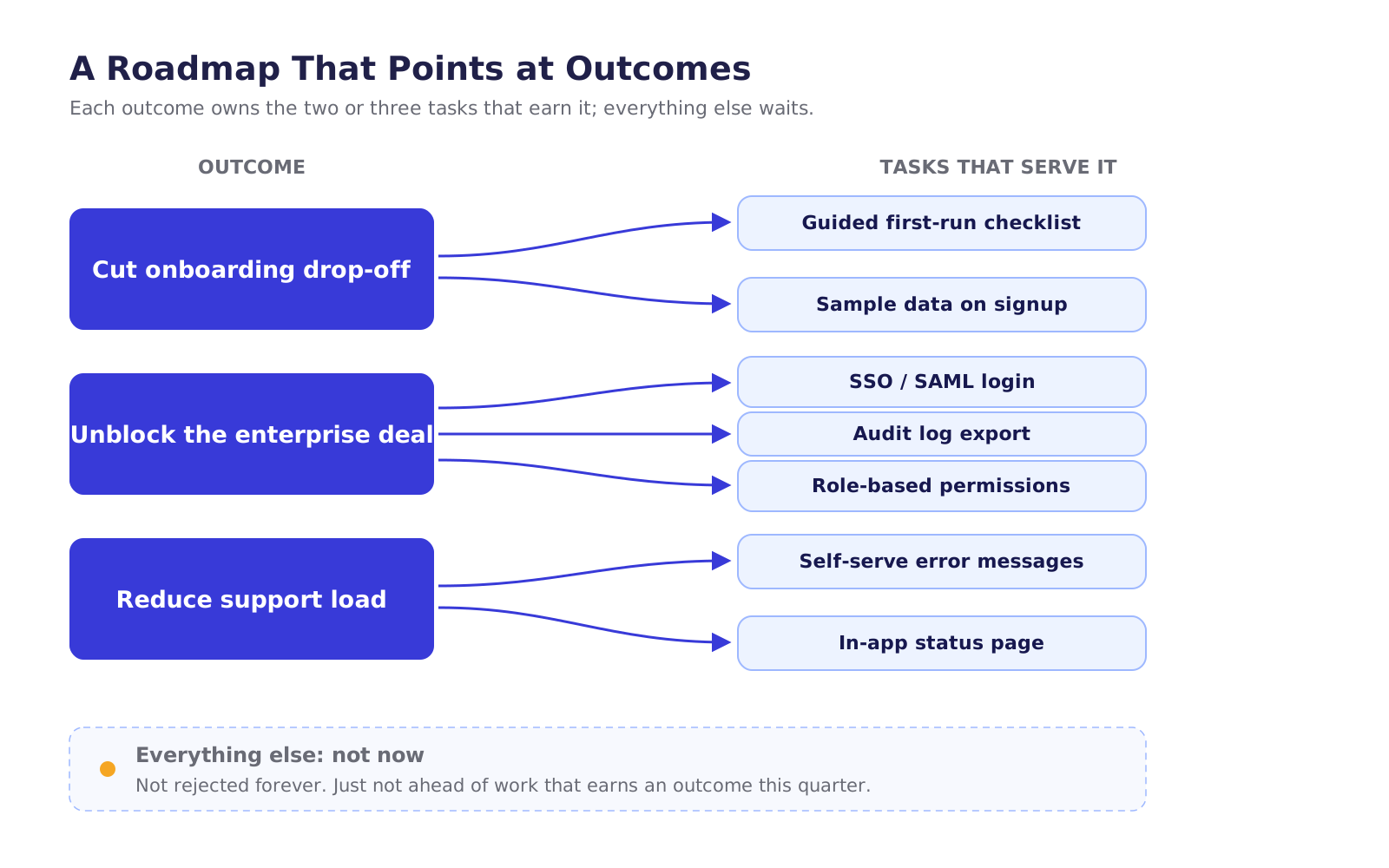
Aligned execution starts before a line of work is scoped. It starts with the question every task has to answer: what business outcome does this serve, and how will we know it worked? If a piece of work can't answer that, it doesn't get built yet. Not rejected forever. Just not now, not ahead of work that can.
The mechanism is plain. Each unit of work carries its business case on its face. The founder, who is not an engineer and shouldn't have to be, can read why a thing is being built without anyone translating. Here's that discipline as a task ticket:
| Field | Entry |
|---|---|
| Task | Add saved-search to the customer portal |
| Business outcome | Cut support tickets from enterprise accounts re-running the same queries (top-3 ticket category, ~40 tickets/mo) |
| Who asked / evidence | Support lead; ticket tags pulled from last quarter |
| Definition of done | Logged-in users can save, name, and re-run a search; saved searches persist across sessions |
| How we'll know it worked | That ticket category drops month over month after release |
| If we skip it | Support load stays; renewal risk on two named accounts cites "clunky reporting" |
Notice what the ticket forces. It names the outcome before the build. It points at evidence instead of opinion. It states how you'll measure whether the bet paid off. And it makes the cost of not doing it explicit, which is how you decide what's actually next. A founder can read that ticket in fifteen seconds and know exactly what their money is buying.
Run every task through that filter and the roadmap stops being a feature list and becomes a sequence of bets, each tied to a number. Some bets miss. That's fine. The point isn't a perfect hit rate. The point is that you find out fast, because every task was small enough to ship and measure on its own, and the misses get cut before they become the 80% that just sits there.
A roadmap reads like a promise to build a list. Treat it instead as a running argument about what's worth building next, settled one shipped task at a time.
This is also where small, task-shaped work quietly does the alignment job for you. When the business changes its mind in month three, and it will, a team mid-way through a monolithic spec has to either plough on building the now-wrong thing or eat the cost of tearing it up. A team working task by task just points the next task somewhere else. The world moved; the next bet moves with it. So alignment stops being a document you write once and becomes a decision you re-make every time you pick up the next piece of work.
Where this lands in practice
For a founder, the test of alignment is uncomfortable and simple. Pull up whatever's being built right now and, for each item, say out loud what business outcome it serves and how you'll know. If you can do it for everything, alignment is owned. If you stall on a few, those are your candidates for the 80%: work in flight that nobody can connect to a result.
Dev on Demand is built so the connection can't go missing. Work arrives as discrete tasks, each one approved by you before the next begins. That approval gate is the alignment check made routine: nothing proceeds until the person who owns the commercial picture has looked at the next task and agreed it's worth doing. You don't need a thousand-page spec or a standing meeting to keep engineering pointed at the business. You need each task to earn its place, one at a time, where you can see it.
Five accountabilities, one map. The next question is how you actually run the work so all five get delivered, and it doesn't start with a spec.
Download the full PDF for free?
Free download — no account required
