Use Case 1: Resume Screening Against a Job
What we're actually building
This is where the ATS plumbing finally does some work. Once you can talk to your ATS (hold a session open, pull a job, read a CV), you have the raw material for the first real piece of automation: an agent that screens one candidate against one role. This page builds exactly that, and explains why its reasoning has to be visible.
The job is narrow on purpose. Take one candidate against one role, and answer a question your team currently answers in 7.4 seconds with a tired eye: is this person worth a closer look? Not "hire them." Not "reject them." Worth a closer look. That distinction is the whole point.
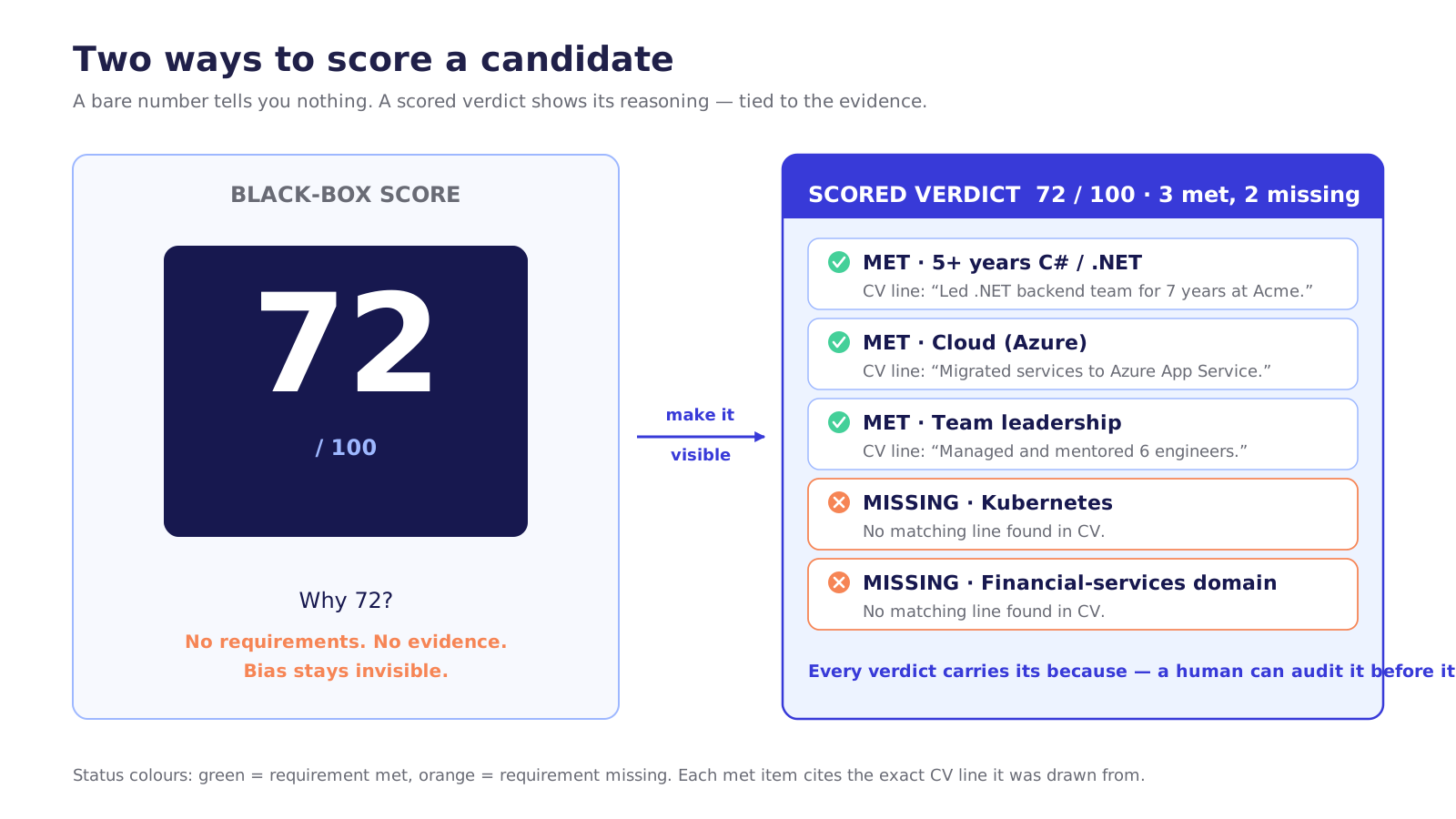
The agent does three things, in order. It reads the role's real requirements from the ATS. It reads the candidate's CV. Then it scores the fit and writes back a verdict, with the reasoning that produced it, in plain English, so a human can agree or overrule in seconds rather than re-doing the work.
Triage, not decision. The agent clears the path; you choose who walks down it.
This is the first cog. It earns its keep on its own before the next one gets bolted on.
Why the reasoning has to be visible
Every agency owner should hear this story once. Now's the time.
In 2018 Amazon quietly scrapped an experimental recruiting tool it had been building since 2014. Trained on a decade of historical CVs (most of them from men), the model taught itself that the strongest signal of a good hire was being male. So it learned to penalise resumes that contained the word "women's" (as in "women's chess club captain"), downgraded graduates of two all-women's colleges, and favoured CVs using verbs more common on male engineers' resumes, such as "executed" and "captured." Amazon couldn't guarantee it had found every proxy the model had invented, so they shut it down (Reuters, 2018).
Here's the part that matters for us. The failure wasn't that the model was biased. Every model trained on human history carries human history's bias. The failure was that the bias was invisible until someone went looking for it. A score with no reasoning is a black box, and a black box that touches hiring is a compliance incident waiting for a name.
So our agent never returns a bare number. Every verdict carries its because: which requirements were met, which weren't, and on what evidence in the CV. Visible reasoning is not a nicety. It's the thing that lets a human catch the Amazon problem before it reaches a candidate, and, not incidentally, the thing the EU AI Act expects of a high-risk recruitment system.
Download the full PDF for free?
Free download — no account required
