Visibility & Accountability
You don't want to run engineering. You shouldn't have to. The whole reason "CTO" looked like the answer was that the title was supposed to come with accountability baked in: one person who owns whether software ships, so you don't have to watch it. The title trap is that the seat fills and the accountability doesn't. You still can't tell, from where you sit, whether this week produced anything you can use.
So let's separate the two things the title was bundling. There's ownership (who is responsible for a given piece of work being done right), and there's visibility (how you, the non-technical founder, can see that it's happening). A good operating system gives you both as a side effect of running the work, not as a separate reporting layer you have to chase.
Ownership: one task, one name
Task-based development makes ownership trivial to assign, because the unit is small enough that one person can own it end to end. The task has a name on it: not a committee, not a "team" or a Slack channel where responsibility quietly evaporates between everyone who could have done something about it. One developer takes the task, ships it, and their name stays attached through review and acceptance.
This is the quiet fix for the bus factor of one. When work arrives as a thousand-page spec handed to a team, ownership smears across everyone and lands on no one, and the only person who really understands the system is the one you can't afford to lose. When work arrives as a stream of scoped tasks, each one is a small, documented, finished thing. The knowledge lives in the tickets and the shipped work, not in one person's head. You can read who owned what, going back months, on a single board.
Here's the ownership map for a typical week, the kind you can read in ten seconds without knowing what any of the code does:
| Task | Owner | State | Acceptance |
|---|---|---|---|
| Add CSV export to the orders report | Priya | In review | Awaiting your approval |
| Fix duplicate-charge edge case at checkout | Marco | Shipped | Approved Tue |
| Wire up the new pricing tier to billing | Priya | In progress | — |
| Email receipts: include VAT line | Sam | Backlog | Not started |
Four rows, each with a name against it and a state you can act on. You're not reading code here. You're reading whether the thing you asked for is moving, and who to ask if it isn't.
Visibility: progress you can read, not a meeting you attend
The standup exists because nobody trusts the board. People gather to say out loud what should already be visible, and a non-technical founder sits there nodding at words they can't evaluate, learning nothing they could act on. That's not accountability. That's theatre with a calendar invite.
Real visibility is a board you can open on your own time and a definition of done you didn't have to write in code. The board moves left to right (backlog, in progress, in review, shipped), and a card only crosses into "shipped" when the work meets an acceptance check written in plain English. You read the check, not the diff.
The test of visibility isn't whether you can attend the standup. It's whether you'd learn anything by skipping it. With task-shaped work and a written definition of done, you wouldn't.
A sample task ticket is what makes this work for a non-technical reader. Notice that everything load-bearing is in language you can evaluate:
TASK-218 — CSV export for the orders report
Owner:    Priya
Context:  Finance is copying orders out by hand every Friday.
          They want a one-click export.
Scope:    Add an "Export CSV" button to the existing orders
          report. Columns: order ID, date, customer, total, status.
          This task does NOT touch the report's filters or layout.
Done when:
  - A button on the orders report downloads a CSV.
  - The file opens cleanly in Excel and Google Sheets.
  - Columns match the five above, in that order.
  - Totals in the CSV match the totals shown on screen.
Acceptance: You (or Finance) export one real Friday's orders
          and confirm the numbers match.
You can check every line of that. You don't need to know how the button was built. You need to know that Finance stopped copying orders by hand on Friday, and the "Acceptance" line tells you exactly how to confirm it. That is the difference between advice by the hour and hands on keyboard: one gives you a recommendation about exports, the other gives you a working button and a way to prove it works.
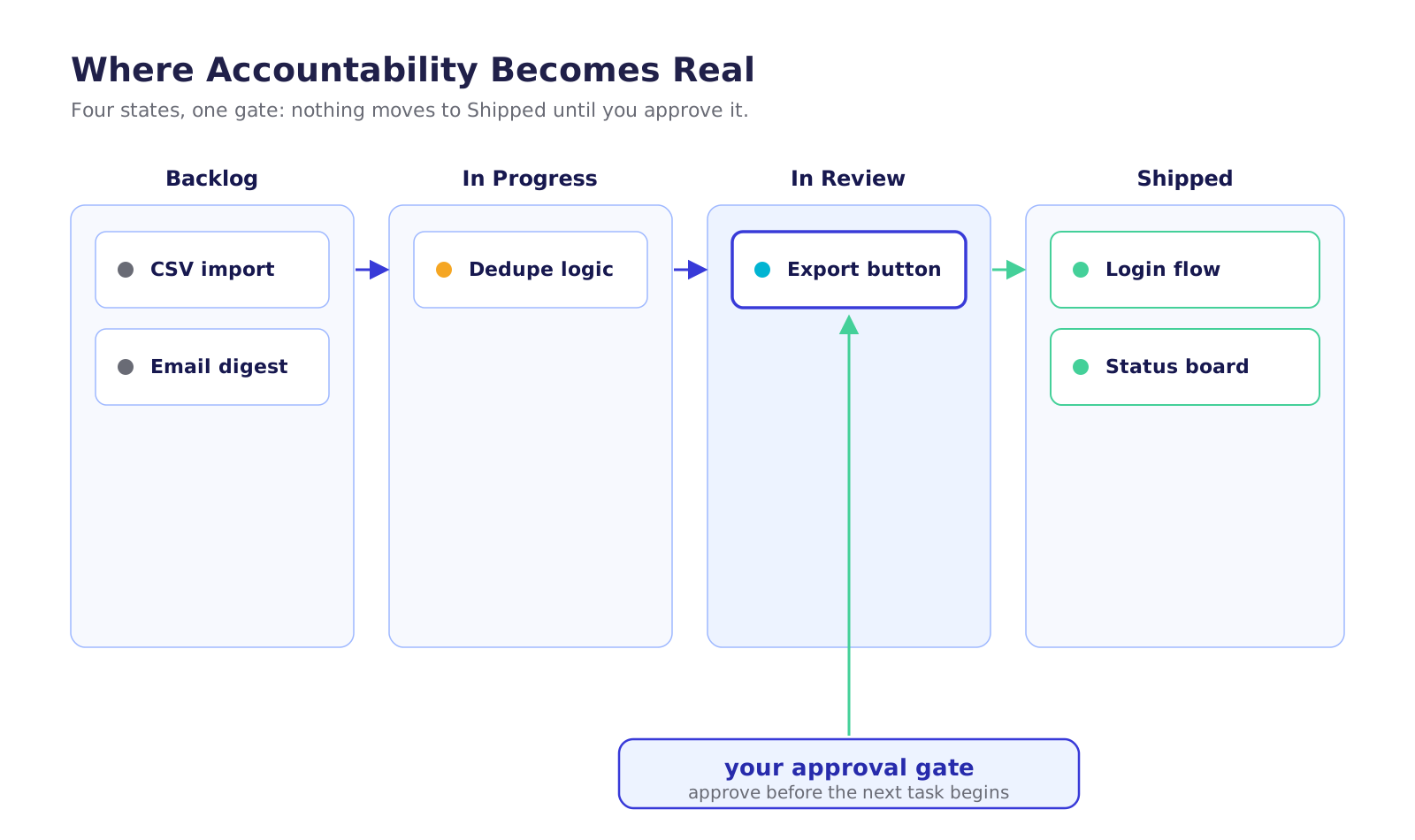
The approval gate is where accountability becomes real
A board you can read is visibility. Accountability needs one more thing: a point where you decide whether the work was good enough, and your decision has teeth.
This is the mechanism in Dev on Demand. Work runs one task at a time, and you approve each completed task before the next one begins. Nothing rolls forward on momentum. If TASK-218 didn't actually let Finance export their Friday orders, it doesn't get marked done because the calendar says it's Friday. It gets marked done when you say the acceptance check passed. The model is built around it, in its own words: one task, one developer, done right, no surprises.
That gate does something a standup never can. It moves the burden of proof onto the work. In a status meeting, the question is "what did you do?" and the answer is a story. At an approval gate, the question is "does this pass the check we agreed on?" and the answer is yes or no, demonstrated. You're not evaluating effort or eloquence. You're evaluating a finished thing against a definition of done you both signed off before the work started.
It also means you're never holding a quarter of unverified work. The cost of a task that missed the point is one task, caught at the gate, not three months of build discovered at a demo. Small units, checked one at a time, is the same principle that makes small projects succeed far more often than big ones (Standish CHAOS 2015) applied to how you govern the work, not just how it's sized.
How this becomes the scorecard
Everything in this chapter is the raw material for the KPIs coming in the next chapter. You don't have to do the counting by hand. The board already records it.
Watch what each artifact quietly measures:
| What you see on the board | What it becomes on the scorecard |
|---|---|
| Time a task spent from "in progress" to "shipped" | Cycle time per task |
| Tasks that came back at the approval gate | Defect escape rate, rework ratio |
| Whether one name owns most of the board | Bus-factor / key-person concentration |
| The "Context" line tying each task to a business reason | % of work tied to a business outcome |
| Tasks you approved vs. tasks you planned | Delivery predictability |
A founder can read all ten of those numbers. The harder question, the one the title was supposed to answer and rarely did, is who is accountable for moving them in the right direction. Hold that thought.
Seeing progress becomes real when it's ten numbers on one page. So here's the page.
Download the full PDF for free?
Free download — no account required
