What a CTO Is Actually Accountable For
The last chapter left you with a question: you have a hole in the org chart, but what's actually missing? A job title doesn't answer that. "CTO" is a label, and labels are exactly what makes the hiring decision so hard. You can't interview for "technical leadership" the way you can interview for "ships a working checkout flow by the end of the month." One is a vibe. The other is a thing that happens or doesn't.
So let's do something the job ads rarely do. Let's take the role apart and look at what's inside it.
The role, decomposed
Underneath the title, a CTO is accountable for five outcomes. These are the five accountabilities, and they are the map for the rest of this book.
| # | Accountability | The question it answers |
|---|---|---|
| 1 | Software delivery | Does the right software ship, on a cadence you can count on? |
| 2 | Team performance | Does the work flow without heroes, bottlenecks, or a single point of failure? |
| 3 | Operational reliability | Does it stay up, and when it breaks, does it come back fast? |
| 4 | Technical quality | Does the codebase stay cheap to change instead of rotting? |
| 5 | Roadmap & business alignment | Is the work tied to a commercial outcome, or are you building features nobody asked for? |
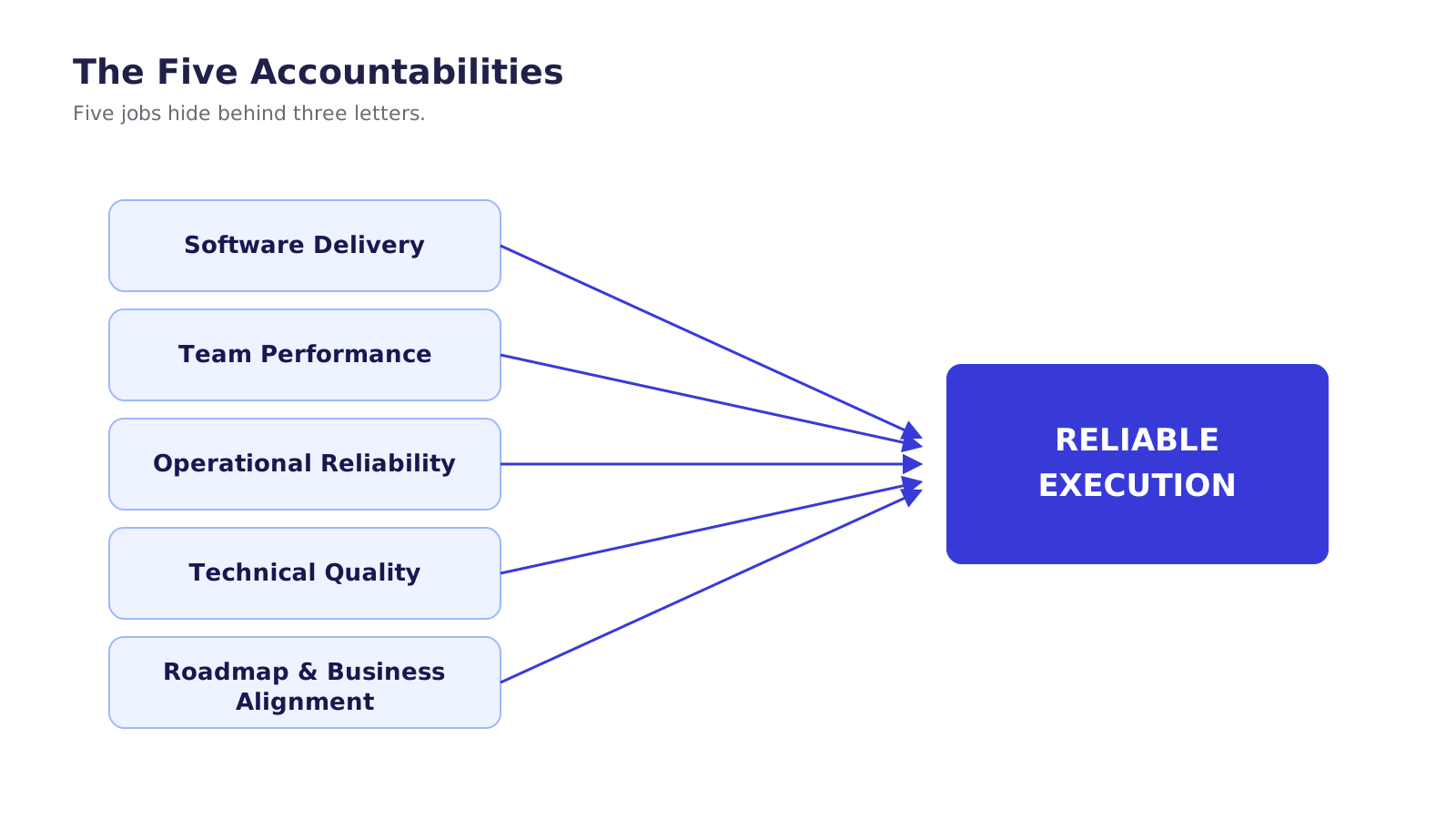
Read that table again and notice what each row has in common. Every one is phrased as a result, not a trait. None of them reads "is a strategic thinker" or "has gravitas" or "communicates a compelling technical vision." Each is instead a state of the world you can walk up to and check. The software shipped, or it sat in a branch. The system stayed up, or customers saw an error page at 9am. There's no personality test that tells you any of this in advance. There's only the work, after the fact.
That distinction is the whole game, so I'll say it plainly. Each of the five is an execution outcome, not a personality you hire. You don't need someone who seems like they could own reliability. You need reliability owned. The two are not the same purchase, and confusing them is how founders end up with an impressive hire and an empty production environment.
Why the public definitions mislead you
Go and read the authoritative descriptions of the CTO role. Splunk's, edstellar's, the Wikipedia entry. They cluster the job into roughly the same five or six areas you see above, which is reassuring. The decomposition isn't something I made up. It's how the people who study the role already carve it.
But watch where the emphasis lands. These descriptions lead with strategy, vision, and roadmap. They talk about "aligning technology investment with business strategy" and "translating technology capabilities into measurable business outcomes." Every bit of that is real and worth doing, and every bit of it sits upstream of the one thing they barely mention: software actually getting shipped.
The conventional definition over-weights advice and under-weights delivery. It tells you what a CTO should think about and goes quiet on what a CTO should make happen.
This isn't an accident of one bad article. It's the gravitational pull of the title itself. "Chief" sounds like a thinking role, so the descriptions fill up with thinking, and the dull, decisive question slides to the bottom of the page. Does anything ship? For a 200-person company with a mature engineering org, the strategic framing is fine. For a growing company that hasn't put working software in front of customers in a quarter, it's a category error. You're being sold vision when what you're short on is output. That is the execution gap, named in the last chapter, showing up again as a flaw baked right into the job description.
The fractional CTO model inherits the same skew, only sharper. A fractional CTO leans toward strategic guidance and oversight while, in one vendor's own words, "eschewing the leadership role of managing teams." That's advice by the hour. It can be genuinely useful advice. It does not, on its own, move any of the five outcomes from "should happen" to "happened."
Each one ships, holds, or fails
Here's the test I want you to apply to all five for the rest of the book. Take any accountability and ask: what does it look like when nobody owns it?
Software delivery with no owner is stop-start. Dates slip without warning, a quarter passes, and nothing reaches production. Team performance with no owner is the bus factor of one, the bottleneck who can't take a holiday, the hire that never closes. Operational reliability with no owner is permanent firefighting and an outage nobody was watching for. Technical quality with no owner is a system the team is quietly afraid to touch. Alignment with no owner is a roadmap full of features that don't trace to a single dollar of revenue.
None of those failures are a leadership-philosophy problem. They're delivery problems. You don't fix a quarter of slipped dates with a better technology vision. You fix it with work, shipped, in a sequence you can see. Which means every accountability you just read is something you can hand to whoever, or whatever, can demonstrably move it. The title is one option. It is not the only one, and it is rarely the cheapest path to the outcome.
And because each is an outcome, each is measurable. That's not a throwaway line. Part IV of this book ends with a scorecard the business can read: two KPIs per accountability, ten numbers on one page. Lead time and delivery predictability for software delivery. Cycle time and key-person concentration for team performance. Change-failure rate and time-to-restore for reliability. Defect escape and rework ratio for quality. Percentage of work tied to a business outcome, and roadmap accuracy, for alignment. Hold that thought. It's the proof that none of this is soft.
The map for what's coming
Part II takes the five accountabilities one chapter at a time. Each chapter follows the same shape: what the accountability really means inside a growing company, what breaks when nobody owns it, and what reliable execution of it actually looks like in practice. By the end you'll have a working definition of the seat that has nothing to do with whose name goes in it.
There's one thing the public lists include that this book leaves out on purpose: innovation and R&D, the "explore emerging tech" mandate. It's a real part of a big-company CTO's job. It is also the wrong thing to optimise for when you haven't shipped reliably yet. A growing company needs a steady drumbeat of delivered software, not a research lab. Where strategy and forward-looking bets belong, they fold into roadmap and alignment, the fifth accountability, rather than standing as a sixth.
So that's the seat, defined as five outcomes you can measure rather than one title you can't evaluate. Now we go where the pain is loudest, and ask the most basic question of all.
Does anything actually ship?
Download the full PDF for free?
Free download — no account required
