Your product team has three flows to redesign before the next release: onboarding, billing settings, and the export screen customers keep emailing support about. You also want a usability round on onboarding before engineering commits to it. You drop all four into a design subscription's request board and wait.
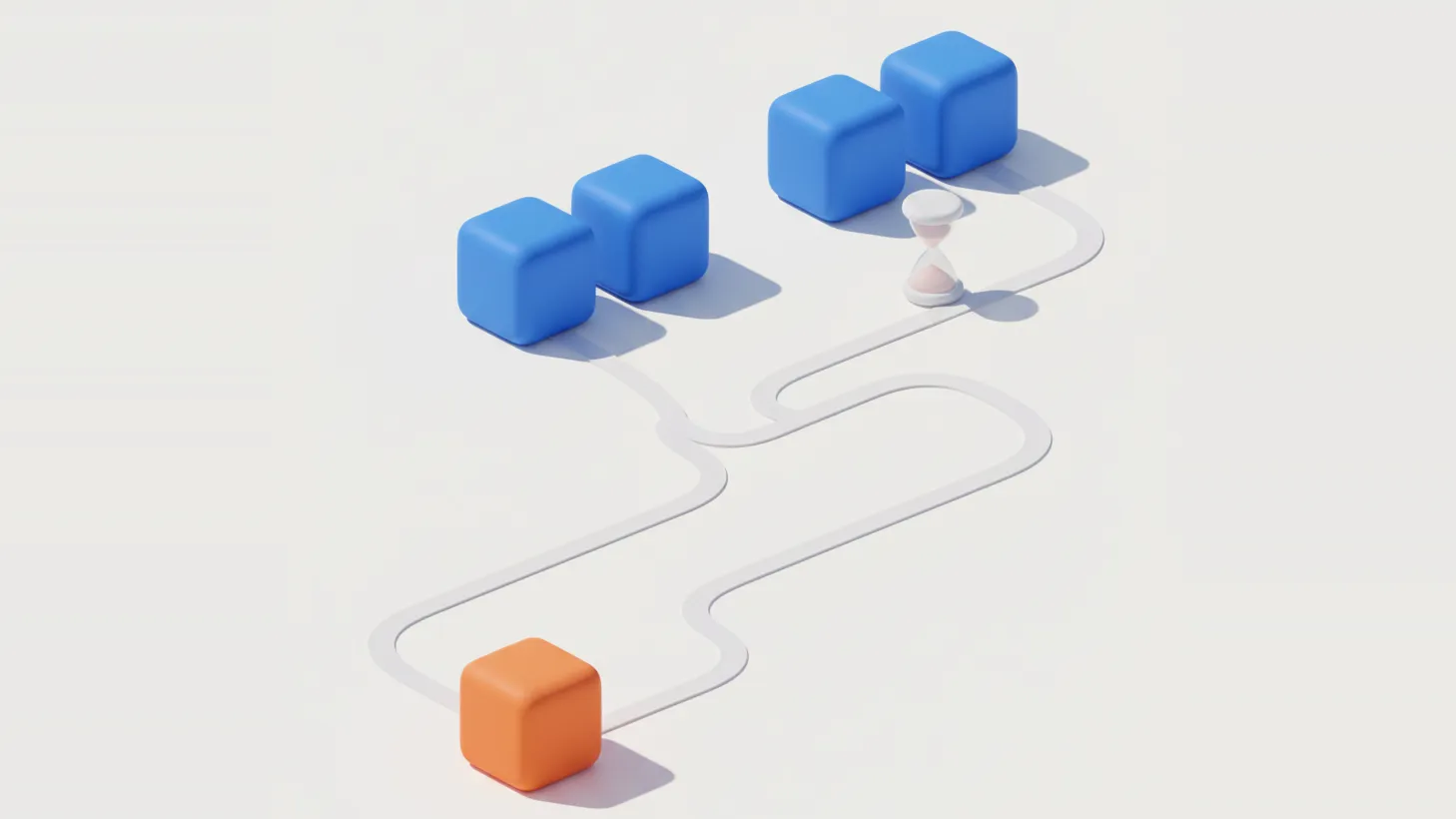
At one request at a time, that isn't a design process. It's a queue.
Designjoy says it does UI/UX, and it does [C5]. So if you're weighing a Designjoy alternative, the question isn't what's on the menu. It's whether the service's shape fits work that is undefined, iterative and parallel.
A UX design subscription is a flat monthly fee for ongoing product design work. For a SaaS team, the test is whether that fee covers research, prototyping, design systems and usability testing, not only screens delivered one request at a time.
Key takeaways
Designjoy's live site lists a single plan, the "Monthly Club", at $4,995 a month [C1]. A struck-through $5,995 sits beside it, and the page labels the $4,995 a "Lifetime Discount - Limited Time" [C1]. The plan includes "One request at a time", "Avg. 48 hour delivery", "Unlimited brands", "Webflow development" and "Up to 2 users" [C2]. Not working for you after a week? You get 75% back, no questions asked [C3].
The shape matters more than the price. In the site's own words: "Designjoy is a one-man agency, ran by Brett, the founder. Designjoy does not employ other designers, or outsource work to any other entity." [C4] It has run since 2017 [C4]. You can queue as many requests as you like, and they "will be delivered one by one." [C4]
The scope is broad: UI/UX sits next to mobile apps and MVP builds, "Most requests are designed using Figma", and the exclusions are things like 3D modeling, video and InDesign work [C5]. So the fair reading is that Designjoy will design product screens. It just designs them as tickets.
One housekeeping note: a ManyPixels comparison (updated 30 September 2026) still quotes a $7,995 Designjoy tier [C15], but the live page shows one plan [C1]. Check the vendor's own page.
Graphics requests arrive defined; product UX arrives as an undefined problem that needs research, testing rounds and iteration. The difference is where the brief comes from.
A landing-page hero, a set of ad sizes, a pitch-deck refresh: you know what done looks like before the designer starts, so a fast sequential queue fits. "Users drop off in onboarding" is a problem, not a brief. Someone has to find the flow, test options with real users, change the design and test again, while engineering waits.
That loop is how usability testing is meant to work. Nielsen Norman Group's well-known finding is that five users surface about 85% of usability problems [C16]. The same piece recommends "3 studies with 5 users each" over one larger study [C16]. Testing comes in rounds, and each round depends on the last.
Design systems stretch the queue further. NN/g defines one as "a complete set of standards intended to manage design at scale using reusable components and patterns" [C18]. Creating and maintaining one, it says, "requires a dedicated team": at minimum one interaction designer, one visual designer and one developer [C18]. In a Figma experiment, participants with a design system "completed their objective 34% faster" [C17]. Figma's own caveat: that is "the maximum time savings one would find in a real-world scenario" [C17].
Neither is a ticket you get back in 48 hours. They're processes with dependencies, and that's the bar a UX design subscription has to clear.
From each vendor's own pricing page, checked 9 October 2026, except Kimp: its pricing page shows local-currency prices, so its US price comes from Kimp's own June 2026 pricing post.
| Vendor | Published price (monthly) | Model | Product-UX work named on the pricing page |
|---|---|---|---|
| Designjoy | $4,995, single plan [C1] | One designer, one request at a time, avg. 48h [C2] [C4] | UI/UX, mobile apps, MVP builds listed; Figma [C5] |
| ManyPixels | $699 / $1,199 / $1,399 assigned designer / $2,599 design team [C6] | Graphics subscription | None [C6] |
| Penji | $995 / $1,995 / $4,500 dedicated team [C7] | Graphics subscription | "UXUI" appears only on the demo-request form [C7] |
| Kimp | $1,397 Graphics plan (Kimp, Jun 2026) [C8] | 3 active requests [C9] | "Website, App and UI Designs"; no UX research, prototyping or design systems [C9] |
| Awesomic | $1,190 Graphic Pack / $2,396 All-in-One, quarterly commitment [C14] | Subscription tiers | UI/UX on All-in-One and Dedicated; UX research only on unpriced Dedicated tier [C14] |
| Superside | From $15,000 minimum, annual term; Dedicated from $30,000; $1,000 software fee on both [C10] | Creative team subscription | UI/UX, product design and design systems listed as specialist production; no research or usability testing [C10] |
| Eleken | $4,599 part-time / $6,599 full-time / $11,999 two full-time; 2-month minimum [C12] | Dedicated product designers | Design system, UX audit [C12] |
| Saasfactor | $6,000 retainer; $15,000 fixed UX redesign in 60 days [C13] | Retainer or fixed project | Prototypes for user testing, design-system foundation, user testing reports, usability review [C13] |
| yousource UX On Demand | $3,495 single stream / $6,795 dual stream | One or two AI-augmented product designers; 3-day task cycle | Fully coded prototypes, Figma design systems mapped 1:1 to front-end components, 5-user test in an example brief |
Design Pickle isn't in the table because it publishes no prices; in its words, "we set the number on the call" [C11].
Notice where the money lands. Designjoy at $4,995 sits between Eleken's part-time and full-time dedicated designers [C1] [C12]. At that price point, you aren't choosing between cheap and expensive. You're choosing a service shape.
Here's a ten-minute test. Search each vendor's pricing page for four words: research, prototyping, design systems, usability testing. If the work isn't named on the page where a vendor commits to what you're paying for, expect to negotiate for it later.
The graphics-first subscriptions name none of the four: not ManyPixels [C6], Penji (whose only UX reference is a "UXUI" option on its demo-request form) [C7], Kimp (website, app and UI designs) [C9] or Design Pickle [C11]. Superside lists UI/UX, product design and design systems as specialist production, but not research or usability testing [C10]. Designjoy lists UI/UX and Figma but no research or usability testing [C5].
Awesomic is the middle case. UI/UX appears on its All-in-One plan, but "High-value UX research" only shows up on the unpriced Dedicated Talent tier [C14]. Research exists, behind a sales call.
The product-UX shops name the work. Eleken lists design systems and UX audits [C12]. Its pricing page doesn't mention prototyping or usability testing [C12]. Saasfactor is the most explicit: its fixed UX redesign includes "Interactive prototypes for user testing", "Design system foundation and scalable component library" and "User testing reports & benchmark comparisons" [C13]. Its retainer adds a "Monthly accessibility and usability review" [C13].
None of this proves a graphics subscription can't produce a decent screen. It shows what each vendor puts its price against, which for product UX is the part you need in writing.
There's a real case for Designjoy. If your work is a steady stream of defined requests (marketing pages, sales collateral, feature-launch graphics, a Webflow site), one designer working through a queue fits well. 925Studios, an agency that sells custom projects, puts it plainly: "Subscriptions work when the design problem is defined and repeating." [C20] And ManyPixels, a competitor, concedes the solo model's upside: "A single designer who handles every request personally is why the output is consistent." [C15]
The sharpest critiques come from vendors with a stake. ManyPixels sells design subscriptions and writes that "The constraint isn't the money, it's the queue." [C15] It also writes that "Unlimited design services execute briefs. They don't write them." [C19] 925Studios goes further: for a SaaS product designed from scratch, "a subscription service will not get you there" [C20]. Read these as arguments, not neutral findings.
The arguments hold up anyway, because they follow from the published terms. One request at a time [C2] and one designer [C4] means your onboarding test round waits behind your billing redesign. It also means, in ManyPixels' words, "no cover when the designer is unavailable" [C15]. If your team already writes sharp product briefs and mostly needs hands, that may be fine. If the brief itself is the hard part, it isn't.
The cheapest way to see how a vendor handles product work is to give them some.
Pick one real flow your team needs fixed. Write the problem, not the solution: "trial users stall on the second onboarding step; we want to know why and what to change." Send the same brief to two or three candidates. Does anyone ask who the users are? Does anyone propose testing before polishing? Do you get a Figma file, a clickable prototype, or a set of questions? How long until you have something to put in front of a user?
That brief will tell you more than any pricing page, ours included. If you're still choosing between a fractional designer, agency, freelancer or subscription, we've covered the four ways to buy design separately.
If you want yousource on that shortlist, here's UX On Demand. One AI-augmented product designer is $3,495 a month. Two designers working in parallel is $6,795, so two briefs move at once instead of queuing. Work runs on a 3-day task cycle with daily async updates, and the single stream has a brief-by-brief approval gate. Deliverables include fully coded prototypes and Figma design systems "mapped 1:1 to your front-end components". Our example checkout-audit brief includes "a 5-user test, prioritised issue list, and annotated fixes". If the matched designer isn't right, we replace them within 5 business days at no charge. You can cancel any time, and you own every Figma file, prototype and asset.
Then run the test: write the onboarding brief this week, send it to your shortlist the same day, and judge the replies side by side.
Designjoy's live site lists one plan, the Monthly Club, at $4,995 a month, labelled a "Lifetime Discount - Limited Time" beside a struck-through $5,995. [C1] A ManyPixels comparison updated 30 September 2026 still quotes a $7,995 tier the live page doesn't show. [C15] If it isn't working after a week, Designjoy refunds 75%. [C3]
Yes. Designjoy lists UI/UX alongside mobile apps and MVP builds, and most requests are designed in Figma. [C5] Its site does not name user research or usability testing. [C5] One designer delivers the work, one request at a time, with an average 48-hour delivery. [C2] [C4]
Look for a pricing page that names research, prototyping, design systems and usability testing. Saasfactor names the most: its $15,000 fixed UX redesign includes prototypes for user testing, a design-system foundation and user testing reports, and its retainer is $6,000 a month. [C13] Eleken offers dedicated product designers from $4,599 a month, with design systems and UX audits. [C12] yousource UX On Demand is $3,495 a month for one product designer or $6,795 for two in parallel, on a 3-day task cycle, with fully coded prototypes and Figma design systems mapped 1:1 to front-end components.
Not the graphics-first ones checked. ManyPixels, Penji, Kimp and Design Pickle don't name usability testing on their pricing pages. [C6] [C7] [C9] [C11] Awesomic lists UX research only on its Dedicated tier, which has no published price. [C14] Saasfactor names user testing reports and a monthly accessibility and usability review. [C13]
Among the product-UX vendors in this comparison that publish a monthly price (yousource, Eleken, Saasfactor), monthly fees checked on 9 October 2026 run from $3,495 for yousource UX On Demand's single stream to $11,999 for two full-time Eleken designers on a 2-month minimum. [C12] Saasfactor's retainer is $6,000 a month. [C13] For comparison, Designjoy's single plan is $4,995 a month. [C1]