GitHub's Octoverse 2024 report ranked the Philippines #18 in the world, with more than 1.7 million developers growing 29% a year [G1, G2]. Then the 2025 report came out — and the Philippines had vanished from it. No ranking, no growth figure, nothing. So we measured what we could ourselves: 57 reproducible queries against GitHub's public API, run on July 30, 2026, to establish how many software developers in the Philippines are publicly visible today. As far as we can tell, this is the first public update on the Philippine GitHub developer population since October 2024.
Key takeaways
Before any numbers, you need to know exactly what our numbers are — and what they are not.
Every original figure in this study comes from GitHub's Search API (/search/users), queried on 2026-07-30 with authenticated requests. Each query string and its result count is preserved verbatim in a snapshot file, so anyone with a GitHub token can rerun the study and check our work.
The critical caveat: GitHub's location: filter matches free text a user typed into their own profile. Our headline count of 47,810 covers only accounts that declared a location containing "philippines." That is a self-selected visible sample. GitHub's own >1.7M figure [G1] came from internal geo-attribution across all accounts, declared or not. Our sample is roughly a 3% visible slice of that population. These two numbers measure different things and must never be conflated. When we say "47,810," read "location-declared visible accounts," never "Philippine developers."
A "location-declared GitHub account" is a GitHub user account whose owner has typed a location containing the country's name — here, "philippines" — into the free-text location field of their own public profile. Location-declared counts measure a country's publicly visible, self-identified developer sample, not its total developer population.
Two checks on the sample. First, undercounting: profiles that declare only a city miss our filter. Manila-only adds 3,670 accounts, Cebu 2,009, Davao 1,279 — roughly 6,958 more, a 14.6% undercount we report separately rather than adding in, because city names occasionally collide with foreign places. Second, internal consistency: our yearly account-creation cohorts sum to 47,807 against a total of 47,810, a three-account drift from the few minutes the collection took, which is the kind of error bar we can live with.
One assumption underpins every comparison in this piece: that developers in different countries, and in different years, declare their locations at roughly similar rates. We can't prove that. We can say the method is identical across all seven countries and all fifteen years measured, on the same day, which is more than most cross-country developer statistics can claim.
With the rules established, here is what we found.
Two honest answers. GitHub's last published count: more than 1.7 million developers as of October 2024, growing 29% year over year [G1], up from more than 1.3 million a year earlier [G3]. Our fresh count: 47,810 location-declared user accounts and 4,453 location-declared organizations, as of July 30, 2026.
They answer different questions. GitHub's figure made the Philippines the #18 developer country on Earth, overtaking Australia [G2]. It is also, as of this writing, twenty-one months old, because GitHub published no Philippine figure in its 2025 report.
Ours is smaller by design (it counts only developers who publicly say where they are) but it is current, reproducible, and sliceable in ways GitHub's aggregate never was. Everything else in this study comes from cutting that sample by year, language, activity, and country.
For scale: GitHub passed 180 million developers globally by its 2025 report [G4], and roughly 25 developers per minute were joining from the Asia-Pacific region [G6]. The Philippine story sits inside one of the fastest-growing regions of the world's largest developer platform. The question is what that growth looks like up close.
Slice the visible sample by account-creation year and a clear shape emerges: a pandemic step-change, a long plateau, and then a break upward.
The early years are what you'd expect: 831 accounts predate 2012, then a steady climb through the 2010s from 773 new accounts in 2012 to 2,595 in 2019, with a small dip in 2018. Then 2020: 3,931 new accounts, a 51% jump over 2019. The timing is consistent with lockdowns pushing a generation of Filipinos toward remote work and self-taught code, though registration data alone can't prove the cause.
What followed was not continued acceleration but a plateau. From 2021 through 2024, new accounts held at roughly 4,500 a year: 4,199, 4,630, 4,709, 4,565. Four years of sideways movement. Which is what makes 2025 notable: 5,909 new location-declared accounts, the biggest year ever recorded, up 29.4% over 2024. On its own, 5,909 is just a number. Against a four-year flat line, a 29.4% break upward is a signal.

And it isn't fading: 2,880 new accounts in 2026 through July 29 — about 13.7 per day, annualizing to roughly 5,000, on pace to be the second-biggest year ever.
Two footnotes worth promoting to body text. First: 56.2% of all visible Philippine accounts — 26,892 of them — were created in 2021 or later. The majority of the country's visible developer community is less than five years old. Second, a coincidence we want to be careful with: our +29.4% for the 2025 cohort lands almost exactly on the +29% GitHub reported for 2024 [G1]. These are different methods measuring different populations in different years, so we make no claim they confirm each other. But when an independent method produces a growth figure of the same order as GitHub's last published one, it suggests the growth GitHub stopped reporting didn't stop happening.
Growth only means something relative to the neighbors, though. And one neighbor complicates the story.
We ran the identical queries for six comparison countries on the same day. Same method, same free-text caveat, same date.
| Country | Visible accounts | 2024 cohort | 2025 cohort | 2025 YoY | 2025 cohort as % of base |
|---|---|---|---|---|---|
| India | 537,132 | 51,968 | 81,642 | +57.1% | 15.2% |
| Indonesia | 121,733 | 9,067 | 11,842 | +30.6% | 9.7% |
| Philippines | 47,810 | 4,565 | 5,909 | +29.4% | 12.4% |
| Singapore | 47,688 | 2,535 | 3,083 | +21.6% | 6.5% |
| Vietnam | 43,619 | 3,452 | 6,413 | +85.8% | 14.7% |
| Thailand | 28,964 | 2,036 | 2,549 | +25.2% | 8.8% |
| Malaysia | 24,149 | 1,734 | 2,382 | +37.4% | 9.9% |
(India is included as the regional gravity well, not a peer; GitHub expects it to become the world's largest developer country by 2028 [G5].)
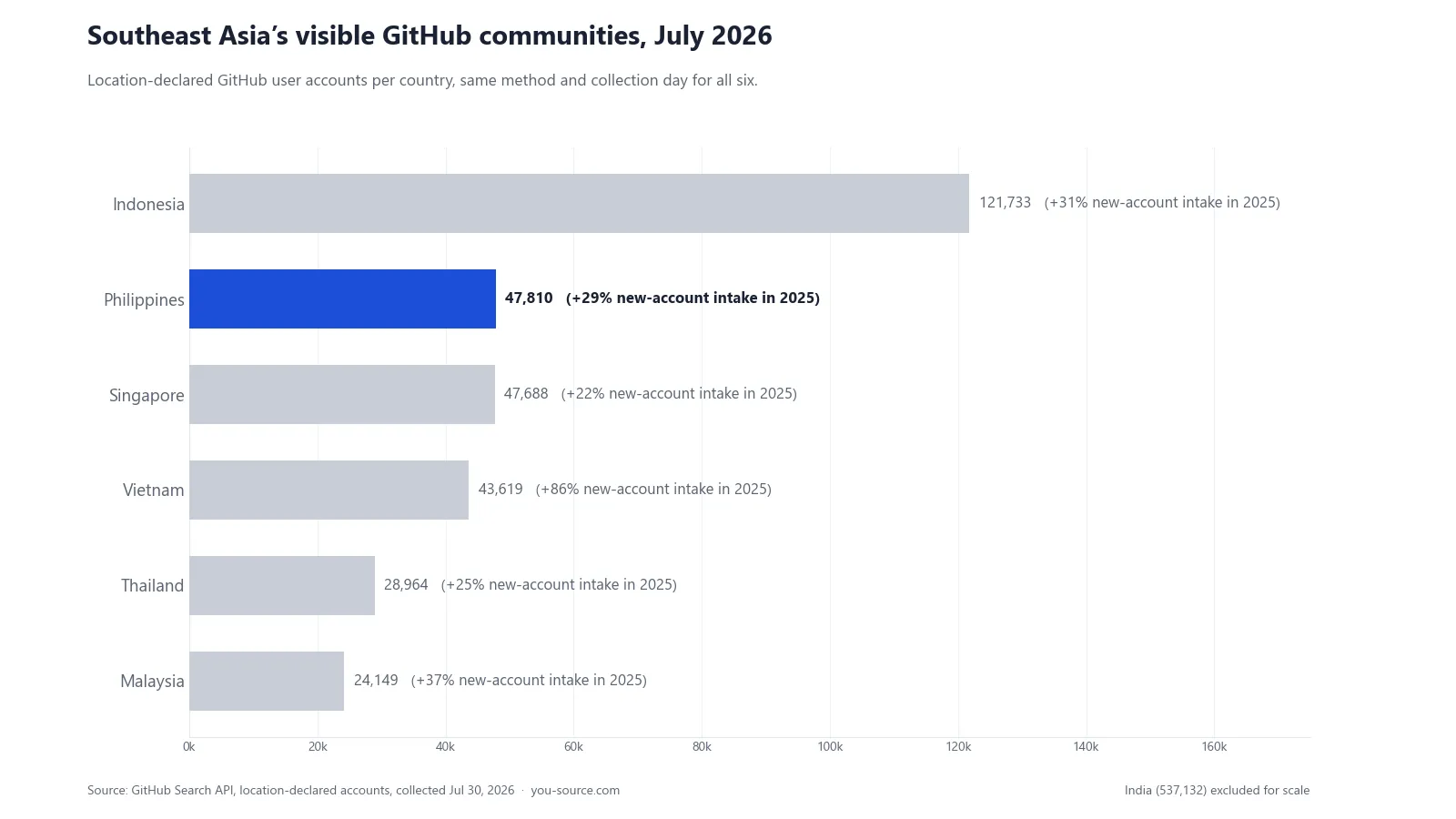
The headline: the Philippines has the second-largest visible developer community in Southeast Asia, behind only Indonesia — and is statistically tied with Singapore in absolute terms, 47,810 to 47,688. Say the honest part too: Singapore reaches that number with a fraction of the Philippines' population, so per capita it isn't close. What the tie does tell you is that the Philippines now fields as many visible developers as Southeast Asia's richest tech hub, and its intake is growing faster: 12.4% of its entire base arrived in 2025 alone, against Singapore's 6.5%.
Indonesia is simply bigger. GitHub's 2025 report — the one that dropped the Philippines — put Indonesia at 4.37 million developers, up from 0.9 million in 2020 [C4]. Its visible sample is 2.5 times the Philippine one, though its 2025 intake relative to base (9.7%) trailed the Philippines'.
Then there is Vietnam, and it deserves a straight paragraph rather than a footnote. Vietnam's 2025 intake surged 85.8% year over year: 6,413 new visible accounts, nearly triple the Philippine growth rate. Its 2025 cohort was 14.7% of its base, ahead of the Philippines' 12.4%. This is not new momentum: GitHub had Vietnam above 1.5 million developers back in 2023, already ahead of the Philippines' 1.3 million [C2, G3], and Vietnam posted 143% growth in contributors to public generative-AI projects in 2024, among the highest anywhere [C5]. If Vietnam's acceleration holds, its visible community overtakes the Philippines' within a few years. If you're evaluating Southeast Asian talent markets, that's a fact you should have, and most vendor content won't hand it to you.
The Philippine developer ecosystem's claim is different: bigger than Vietnam today, growing faster than Indonesia, Singapore, and Thailand relative to base, and, as the next section shows, concentrated in a particular kind of stack.
Of the visible sample, 17,177 accounts have enough public code to attribute a dominant language. Here is how they split:
| Language | Users | Share of attributed |
|---|---|---|
| JavaScript | 5,208 | 30.3% |
| Python | 2,970 | 17.3% |
| PHP | 2,694 | 15.7% |
| Java | 2,589 | 15.1% |
| TypeScript | 1,245 | 7.2% |
| C# | 1,096 | 6.4% |
| Ruby | 703 | 4.1% |
| Dart | 248 | 1.4% |
| Kotlin | 166 | 1.0% |
| Go | 120 | 0.7% |
| Swift | 99 | 0.6% |
| Rust | 39 | 0.2% |
The picture is a web-services economy. JavaScript and TypeScript together account for 37.6% of attributed users, and JavaScript outnumbers TypeScript about 4.2 to 1 — a ratio that says the community's center of gravity is still classic web work rather than the typed, tooling-heavy stacks of newer teams. Add PHP at 15.7% and Java at 15.1% and you're looking at a deep bench in exactly the technologies that run most business software: web frontends, CMS and e-commerce backends, enterprise Java, .NET.
Read the bottom of the table as a supply signal, not a shortcoming. Go and Rust combined are under 1% of attributed users — 159 people in the entire visible sample. If you're hiring in the Philippines for web application work, Python services, or Java/.NET modernization, the pool is deep and getting deeper. If you need Rust systems engineers, the visible pool is 39 accounts and you should plan accordingly — train, or look elsewhere. Knowing which market you're in before you post the req is worth more than any averaged "talent score."
Depth of talent is one thing. Whether the world can see it is another.
The Philippine sample is active but almost invisible at the top. Build the pyramid: 73.1% of visible accounts have at least one public repository — 34,940 people shipping something in public. A quarter (12,197) have ten or more repos; 1,484 have fifty or more. Then the influence tiers collapse. Just 254 accounts (0.53%) have 100 or more followers. Twelve accounts in the entire country have 1,000 or more.
Twelve. A community of nearly 48,000 visible developers, second-largest in Southeast Asia, has twelve people with meaningful global open-source followings. The talent base is deep; the celebrity layer barely exists.
That gap distorts how the world measures the country. Stack Overflow's 2025 survey drew 49,019 respondents; 141 of them (0.4%) were from the Philippines [S1]. This for a country GitHub ranked #18 globally [G2]. The surveys that shape hiring narratives, salary benchmarks, and "state of the developer nation" reports structurally under-sample the Philippines, because they sample where developer mindshare is loud, not where developers are. Then GitHub dropped country-level Philippine data from Octoverse 2025 entirely, and the last channel that did count the country went quiet.
Which is the argument for this study existing. When the platforms stop publishing and the surveys can't see you, the only current Philippines software development statistics are the ones you count yourself.
The GitHub data lands inside an industry that has started saying, out loud, that its growth model is changing.
The Philippine IT-BPM sector — the outsourcing engine that includes everything from contact centers to software delivery — cleared $40 billion in export revenue in 2025, up 5% [I1], employing 1.9 million people [I3]. It is the second-largest global delivery location for these services, with a 16–18% share of the world market as of the 2022 baseline [I5]. IBPAP, the industry association, projects roughly $42 billion and 1.97 million full-time employees by end-2026 [I2]. Feeding it: Philippine universities produced an average of about 87,000 IT-related graduates a year across 2016–2021, the most recent official figures available [E1].
But in July 2026, IBPAP cut its own 2028 roadmap targets, citing the AI transition: from $59 billion and 2.5 million jobs down to a best case of $50.5 billion and 2.14 million, with a downside scenario of $43.3 billion [I4]. IBPAP president and CEO Jack Madrid put it plainly: "We need to review where we are and be honest about what we can achieve realistically" [I4].
Read those two datasets together and the story sharpens. The industry's own association is saying the era of growth-by-seat-count is ending: AI is compressing exactly the routine work that headcount arbitrage — the classic IT staff augmentation model — was built on. Meanwhile the GitHub data shows individual capability formation accelerating: record account creation, a majority-under-five-years-old community, tens of thousands of people publishing code in public. Revenue per role, not roles, is where Philippine growth now has to come from. The GitHub numbers are the closest thing we have to a live gauge of that capability forming — which is precisely why it matters that the official channels stopped publishing them.
For a CTO weighing software developers in the Philippines against other Southeast Asian markets, the practical summary is short. The Philippines offers one of the largest developer pools in Southeast Asia, and one of the youngest — 56% of its visible community joined GitHub within the last five years — growing at a record pace, with the second-best English proficiency in Asia (ranked 28th of 123 countries globally, against Vietnam at 64th and Indonesia at 80th) [X1, X2].
On cost, Payscale's self-reported aggregate puts the average software engineer base salary at ₱470,138 a year, though that rests on just 421 profiles, so treat it as indicative [X3]. For the fuller picture, see our breakdown of the cost to hire a developer in 2026.
Deep web-stack talent, strong communication, structural cost advantage: this is the pool You-Source has built on for years, and the reason our Dev on Demand model — dedicated AI-augmented engineers on a flat monthly subscription — draws from it. If you're comparing outsourcing partners instead, start with our guide to the top software development companies in the Philippines. And if the data above changed how you think about where capability is forming, that's the conversation to have — see how Dev on Demand works.
There is no single current official figure. GitHub's last published count put the Philippines at more than 1.7 million developers as of October 2024, ranked #18 in the world [G1, G2]. As of July 30, 2026, this study counts 47,810 location-declared GitHub user accounts in the Philippines — a smaller, self-selected visible sample, but the most current reproducible measurement available.
Yes, at a record pace by the visible measure. 2025 produced 5,909 new location-declared Philippine GitHub accounts — the biggest year ever recorded and a 29.4% increase over 2024. In 2026, through July 29, the Philippines had already added 2,880 accounts, about 13.7 per day, on pace to be the second-biggest year on record.
JavaScript leads at 30.3% of location-declared Philippine GitHub accounts with an attributable dominant language, followed by Python at 17.3%, PHP at 15.7%, and Java at 15.1%. Systems languages are rare in the visible sample: Go and Rust combined account for under 1% of attributed users.
GitHub has published no reason. Its Octoverse 2024 report ranked the Philippines #18 worldwide with more than 1.7 million developers [G1, G2], but the 2025 Octoverse report simply contains no country-level Philippine figure. This study's 47,810 location-declared account count, collected July 30, 2026, is an independent attempt to fill that gap with a reproducible public measurement.
Original data ([D1]–[D24]): You-Source analysis of the GitHub Search API (/search/users), 57 documented queries collected July 30, 2026. Query strings and result counts preserved in the study snapshot.